21cmEMU: an emulator of 21cmFAST summary observables

Speeding up 21 cm inference with machine learning
Even though we make 21cmfast as fast as possible, creating full 3D simulations of the Universe tens of thousands of times to infer the astrophysical parameters governing the cosmic dawn and epoch of reionization is still a pretty big lift. One inference run can take weeks on a supercomputer, which limits our ability to explore new models. What’s more, it’s pretty common for us to want to constrain the same model for different combinations of data. For example, we might want to see how our constraints change when we add in a new observation, or swap out one dataset for another. Re-running the full inference for each new combination of data is simply not feasible.
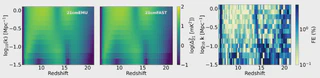
To get around this problem, we’ve developed 21cmEMU, a machine learning-based emulator of 21cmfast summary observables like the global 21 cm signal and the 21 cm power spectrum. 21cmEMU uses neural networks to learn the mapping from astrophysical parameters to summary observables, allowing it to generate predictions in milliseconds instead of hours. While it requires an initial investment of time to produce a “training set” of simulations, once this is done, 21cmemu can quickly provide predictions for new combinations of parameters or datasets.
This allows us to ask important questions like “what is this particular piece of data adding to our knowledge?”. It is also hugely beneficial for generating forecasts for upcoming experiments, which often require exploring a wide range of models and scenarios.
While several emulators of 21 cm observables have been developed in the past, 21cmEMU is the first to directly emulate 21cmFAST, the most widely used simulation code for 21 cm cosmology. It is also the first to simultaneously emulate a range of summary observables, including the global signal and power spectrum at multiple redshifts, as well as the electron scattering optical depth, mean neutral fraction history, and UV luminosity functions. This makes it uniquely powerful for parameter inference, which requires all of these observables to provide meaningful constraints.
What’s next?
This work was led by Daniela Breitman as part of her PhD thesis. We continue to collaborate on new ways to incorporate machine learning into 21 cm cosmology, including improving the accuracy and flexibility of 21cmEMU itself.
