The EDGES measurement disfavors an excess radio background during the cosmic dawn

Revisiting the EDGES low-band measurement
The Experiment to Detect the Global Epoch of Reionization Signature (EDGES) collaboration made headlines in 2018 when they reported the detection of an unexpectedly deep 21 cm absorption feature centered at 78 MHz in their (I suppose I should say “our” now, though I joined the collaboration after this result was published) low-band data. This result sparked a flurry of theoretical activity, as the depth of the absorption feature was more than twice as large as the maximum allowed by standard astrophysical models. To explain this discrepancy, theorists proposed a variety of exotic scenarios, including interactions between dark matter and baryons, as well as the presence of an excess radio background beyond the cosmic microwave background (CMB) at these redshifts.
However, most of the physical models proposed to explain the EDGES result focused on reproducing the depth of the absorption feature, without fully accounting for the detailed shape of the measured spectrum. In this work, we re-analyze the same EDGES low-band data, but with three key improvements over previous analyses. First, we account for the possibility of small instrumental systematics that could affect the measured spectrum (similar to Peter Sims’ excellent 2019 paper). Second, we use the full data spectrum, simultaneously fitting for the foregrounds, instrumental effects, and 21 cm signal, rather than just focusing on matching the depth of the absorption feature. Finally, we use a new physically-motivated model that self-consistently allows for excess-radio-background scenarios at high redshift while naturally “turning off” the excess background at low redshift to match existing observational constraints.
Surprising results: no evidence for an excess radio background
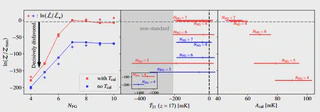
Contrary to previous interpretations of the EDGES result, we find that when accounting for possible instrumental systematics and using a more accurate physical model, the data do not favor the presence of an excess radio background during the cosmic dawn. In fact, our analysis disfavors such scenarios at high statistical significance.
Instead we find that the EDGES data prefer models with standard astrophysics and no excess radio background, with a low but non-zero level of residual systematics.
Why did we reach different conclusions?
When we fit our more physically-motivated model directly to the best-fit absorption profile reported by EDGES, we do find that an excess radio background is required to match the depth of the feature. However, this common approach neglects the interplay of foregrounds, instrumental effects, and the 21 cm signal. When simultaneously fitting for all of these components to the raw data, we find the opposite conclusion: the data do not favor an excess radio background. This highlights the importance of using principle Bayesian inference methods and accurate physical models when interpreting global 21 cm measurements.
Our investigation suggests that the primary factor driving the favoured models away from excess radio backgrounds is the shape of the measured spectrum, rather than the depth of the absorption feature alone. The extremely sharp evolution in the absorption profile reported by EDGES is difficult to reconcile with physical models that must evolve smoothly over cosmic time. This tension is alleviated in our analysis by allowing for small instrumental systematics, which can mimic sharp features in the spectrum. However, once these systematics are accounted for, the data no longer require an excess radio background at all.
What’s next?
Our results depend on the assumption that the small instrumental systematics we model are indeed present in the EDGES data. Future work should aim to better understand the instrument and its calibration to confirm or refute this assumption.
In the meantime, the next-generation version of the EDGES instrument, EDGES-3, is currently taking data with improved design and calibration techniques. We eagerly await results from EDGES-3, which will provide a fresh opportunity to probe the global 21 cm signal during the cosmic dawn and test the conclusions of this work.
