matvis: a matrix-based visibility simulator for fast forward modelling of many-element 21 cm arrays

A faster way to connect models of the radio sky to interferometric observations
Radio interferometers like HERA and the SKA don’t “see” the sky directly like we imagine with optical telescopes. Instead, they measure something called “visibilities”, which are complex-valued correlations between pairs of antennas. To interpret these visibilities in terms of the underlying astrophysics, we need to simulate what visibilities would be measured for a given model of the radio sky. This process is called “forward modelling”, and it’s essential for connecting theoretical models to real data.
However, simulating visibilities for modern arrays with huge numbers of antennas (350 for HERA, 512 for the SKA!) is computationally challenging. Since visibilities are measured for each pair of antennas, the number of visibilities scales as the square of the number of antennas. This makes traditional simulation methods slow and resource-intensive, limiting our ability to explore large parameter spaces or generate many mock observations.
What is matvis?
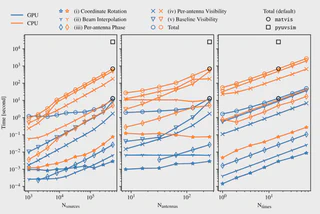
matvis is a new GPU-accelerated matrix-based visibility simulator for many-element 21 cm arrays that opens up the possibility of simulating mock observations on unprecedented scales. Fundamental to matvis is a reformulation of the visibility simulation problem in terms of matrix operations, which can be executed extremely efficiently on modern GPUs. By leveraging the parallel processing power of GPUs and optimizing memory usage, matvis achieves significant speed-ups (more than a thousand-fold!) compared to traditional CPU-based methods.
What did we do in this work?
In this paper, we introduce matvis and demonstrate that despite its speed, it produces accurate visibility simulations. We validate matvis against traditional simulation methods, showing excellent agreement in a variety of test cases. We also showcase matvis’s ability to simulate visibilities for large arrays like HERA and the SKA in a fraction of the time required by traditional methods.
Who can use matvis?
matvis is open-source and freely available to the community! You can find the code on GitHub, along with documentation and examples to help you get started. While matvis was developed by the HERA collaboration, it is not specific to HERA and can be used for simulating visibilities for any many-element 21 cm array – including those that are not focused on 21 cm cosmology. Importantly, matvis is included in the list of supported simulators for the hera_sim package, making it easy to integrate into existing workflows for simulating HERA observations.
What’s next?
Looking ahead, we plan to continue developing matvis by adding new features and improving its performance. For example, in the paper we outline an experimental algorithm that may improve performance for highly-regular arrays like HERA even further.
We also hope to see matvis adopted by the broader community for a variety of applications, which is why we’ve made it open-source and easy to use. If you’re interested in using matvis for your own work, please check out the Github repository!
